


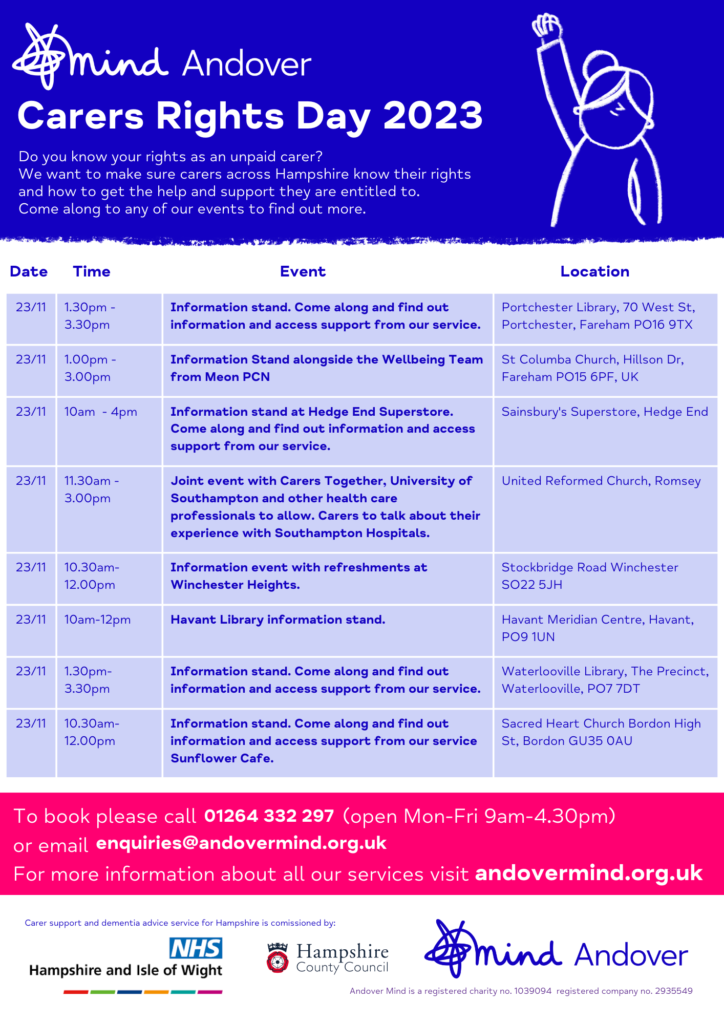
Carers rights day 2023 is on 23 November and we have a lot planned in our local communities.
See our full timetable below!
Below the timetable, we have also listed more information about qualifying as an unpaid carer, what your rights are and what benefits you may be entitled to claiming.

Are you a carer?
The government describes a carer as:
A carer is someone who helps another person, usually a relative or friend, in their day-to-day life
They go on to say:
Where it appears to a local authority that a carer may have needs for support (whether currently or in the future), the authority must assess — whether the carer does have needs for support (or is likely to do so in the future), and if the carer does, what those needs are (or are likely to be in the future).
As an idea, the NHS says you’re a carer if you’re doing any of the following on a regular basis for someone that is ill, elderly or disabled, practical support, including:
- washing, dressing or taking medicines
- getting out and about
- travelling to doctors’ appointments
- shopping, and cleaning
- organising finances and paying bills
- emotional support, including:
- sitting with someone to keep them company
- watching over someone if they can’t be left alone
- fielding telephone calls to manage someone’s anxiety
Know your rights!
Notes on carers’ rights:
- It is illegal to coerce or force someone to be a carer, or to demand they do certain tasks and hours.
- If we choose to be a carer, we have the right to say what we are willing and able to do for the person we care for – and be supported in that choice.
- Carers have the right to a view on how care & support is organised for the person they care for.
- Once we have had a carer’s assessment, we should expect to receive a support plan, as well as the conditions on which any financial support is given. The carer’s assessment is an opportunity for us to define our caring role, talk about the impact and look at any changes we wish to make.
- The right to flexible working is only a request, which may be negotiated with our employer; depending on the employment situation, flexibility may not be an option. If our employer refuses to consider our request, they may be in breach of the law; if they cannot offer flexibility, they must explain why it’s not possible.
- Carers are entitled to live fulfilling lives – therefore we have the right to do what we want to, alongside our caring role. Any attempt to prevent us from doing that, by withdrawing support, etc, is illegal.
- Under the Equality Act, being a carer is not a protected characteristic; however carers are protected by association with someone who has a disability, long-term condition, etc. This is for the provision of goods and services.
- Know that we have the right to make changes to our caring role at any time.
- The responsibility (the duty of care) for the care and support of cared-for adults lies with the local authority, not us!
Carers rights: Benefits you may be entitled to
Carer’s allowance
This is the main benefit for carers. It applies to those of us caring for at least 35 hours a week, and earning less than £132 a week. Find out if you’re eligible today.
Carer’s credit
This benefit often gets overlooked. It’s not a payment, but a credit which counts towards our National Insurance record. When we care more, we often have to reduce our working hours or quit work entirely. Meaning it becomes less likely that we are able to pay into National Insurance. Carer’s Credit fills in this gap. By accruing the credit, it opens doors to future benefits such as State Pension.
Attendance allowance
This is a benefit for the person we care for, not for ourselves as carers. However, if the person we care for is eligible for Attendance Allowance, then they may be able to ‘buy in’ some support, such as a cleaner, a paid carer or a gardener. This could reduce the amount of time we spend in our caring role.
Universal credit
If you are on a low income, then you may be entitled to Universal Credit even if you are receiving Carer’s Allowance.
For more information and guidance on being an unpaid carer, please call us on 01264 332297.
< Back to news

